
Expanding the Industries of Ideas
Expanding the Industries of Ideas: Understanding the link between research investments, jobs, and skills
The Industries of Ideas (IofI) project is developing new, forward-looking measures of the workforce and economic impact of research investments in emerging industries. The project is funded by the National Science Foundation’s Technology, Innovation, and Partnerships Directorate (TIP), which has awarded the IofI project $10 million to address the crucial need for transparent and trusted information about the relationship between federally funded research in critical technologies like artificial intelligence (AI) and jobs, skills, and earnings.
Currently, investments in science and technology research and development are generating new “idea industries” that do not align neatly with traditional measures of scientific fields and industries. These emerging industries will profoundly affect how people work in nearly every employer and industry. This work expands upon an NSF pilot investment in the state of Ohio that developed the foundation for tracing how idea industries are formed by detecting flows of people moving into jobs and firms from federally funded research projects and the effects of those flows on the state’s workforce.
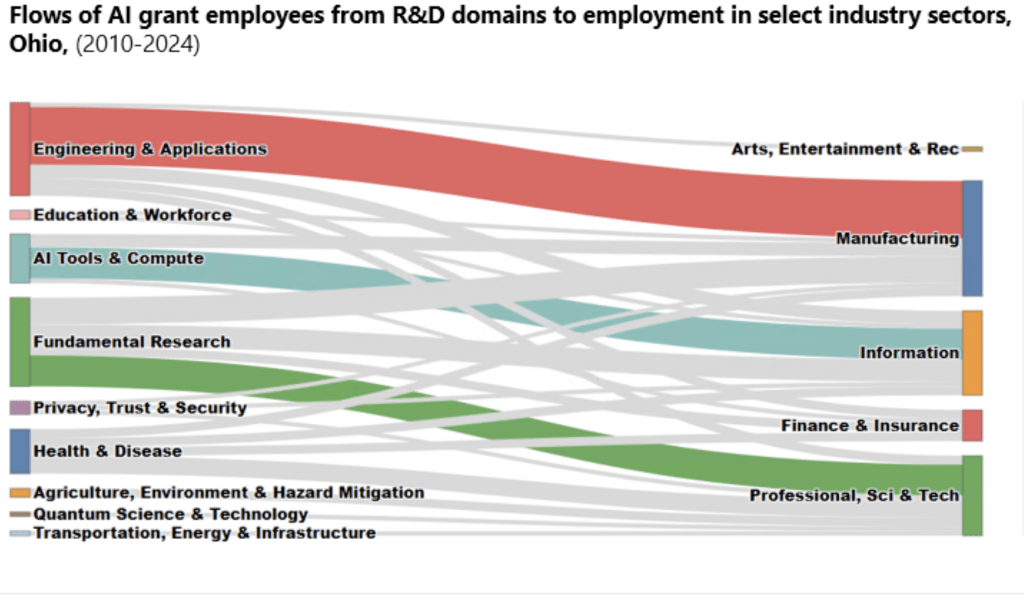
The IofI expansion brings together state and local agencies, universities, education agencies, and economic developers to create tools that provide timely, local, actionable data to inform key business and policy decisions and prepare for technology-driven workforce changes.
About the Expansion
Richer Data:
A key IofI contribution stems from its integration of many constituencies and datasets, including science and technology metadata, data from universities, state workforce and state higher education agencies, and job postings and skills data.
Broader partnerships:
This new collaboratively developed empirical framework, data, and infrastructure will, for the first time, directly engage state institutions, data users, and producers to quantify relationships among research investments, regional job markets, local workforce dynamics, and other key economic outcomes of technology investment. The project works with local businesses, chambers of commerce, state labor market, education, and economic development agencies, and state governors.
Scalable insights:
The project focuses initially on investments in AI to develop an approach and empirical methods that can be scaled to any science and technology domain and economic sector.
Partners
IofI partners include: The National Association of State Workforce Agencies, New York University, Institute for Research on Innovation & Science, Center For Regional Economic Competitiveness, Ohio State University, Ohio Department of Job & Family Services, Arkansas Department of Shared Administrative Services, National Science Foundation, University of Michigan, The New Jersey Department of Labor & State Workforce Development, and The Multi-State Data Collaborative.
This material is based upon work supported by the U.S. National Science Foundation under Grant No 2518186. Any opinions, findings, and conclusions or recommendations expressed in this material do not necessarily reflect the views of NSF.
Learn More
- Industries of Ideas Website
- NSF Award Details
- About the Pilot
- How to track the economic impact of public investments in AI | Nature article by Julia Lane, Jason Owen-Smith & Bruce A. Weinberg
- AI and Jobs: Measuring Impact and Building New Assessment Tools | AEI presentation by Jason Owen-Smith
Project Timeline
- In the pilot phase, this project developed a prototype dashboard to measure the economic impact of federal investments in artificial intelligence and electric vehicle research on regional firms and jobs in Ohio.
- In expansion year 1, this project will extend the prototype’s scope to include higher education and skills data and begin to collaborate with other state participants through extensive outreach anchored on the collaborative, stakeholder-driven product design process that was fostered in the initial prototype. Initial data extensions begin in year 1 in collaboration with the State of New Jersey.
- In expansion year 2, the project will work with key communities to prototype community-designed information products and facilitate the addition of eight to ten additional states.
- In expansion year 3, the project will begin the process of scaling and measurement validation by providing implementation tools to those additional states.
This project builds on established and successful data systems at IRIS. Universities that join the IRIS consortium will be well-positioned to help define, expand, and benefit from the new data systems developed in this project. Visit our membership page for more information.



© 2026 The Regents of the University of Michigan | Ann Arbor, MI 48109 USA | Phone: +1 (734) 764-1817